SPORT MUST EMBRACE CONTINUING EDUCATION, RESEARCH, TRAINING AND PROFESSIONALISM
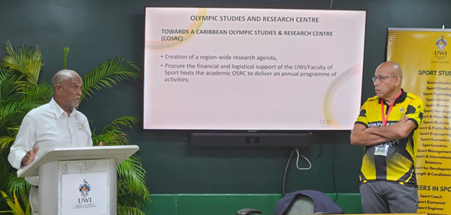
Last week I had the distinction of delivering a presentation to the Faculty of Sport of the University of the West Indies. The focus of the presentation was the possible creation of a Caribbean Olympic Studies and Research Centre under the ambit of the Faculty of Sport and with the support of the Caribbean Association of National Olympic Committees (CANOC).
CANOC’s interest has long been piqued by the dearth of research in sport across the Caribbean, a fact that has allowed for some ridiculous pronouncements in respect of the achievements of several of our Caribbean athletes and coaches. This is not new. The African distance runners have had the same experience when they began to dominate the events. The reality is that once black athletes began to prove themselves equal to or better than their white counterparts in several different sports, those nations with a history of scientific research eagerly sought answers for their concerns as to identify ‘cause’ on order to respond appropriately on the field of play.
Unfortunately, in the Caribbean, academic research has been long in coming. Our oral tradition allowed for easy, top-of-head analyses and often unsubstantiated explanations for the performances of our athletes. What many in the Caribbean did not know is that while we essentially took to heart some of the explanations of our athletes’ performances, the more advanced industrial, wealthy nations, commissioned scientific research to find their own explanations for our athletes’ continued prowess.
In the Caribbean,we are not ony decidedly late in conducting research into our sporting successes, but we have also been particularly recalcitrant in recording our sporting history, from origins to today. In this regard, we have been our own worst enemies. Not surprisingly, as is the case with our general history, we have allowed others from outside our region an dculture to chronicle and explain must of what we have today as Caribbean sporting history.
Sad!.
UWI-CANOC Relationship
In a recent message to the members of CANOC, the organisation’s President wrote, ‘It was on Sunday 8 October 2023, at the 21st CANOC General Assembly in Bridgetown, Barbados, Dr. Akshai Mansingh, then Dean of the UWI Faculty of Sport and CANOC President, Keith Joseph signed a Protocol of Cooperation Agreement which established collaboration undertake training, education and business activations in, but not limited to, the following areas or fields: Sport Education and Action Research, Olympic and Paralympic principles and values and programmes and initiatives of the respective movements, Fair Play, Good Governance, Anti-doping and Safeguarding of athletes, High Performance, Community and Recreational Sport, Women in Sport, Sport for All and for Global Peace and International Community, and other areas which the Parties may consider necessary in promoting and realizing the said objective.’
Since the signing of the MoU, CANOC and UWI have been engaged in extensive and expansive collaboration on an ever-expanding range of issues aimed at enhancing the sport culture of the Caribbean.
At the time of writing this Column, the UWI’s Sports Academy on the St Augustine Campus, Trinidad and Tobago, is completing the grading of exam papers submitted by the 33 Caribbean participants in the Advanced Governance and Sport Leadership Course.
Discussions are also taking place on the development of a Course in Sport Economics for the Faculty of Sport.
Newly appointed Dean of the Faculty of Sport, Dr Roy Mc Cree, is insistent that the time has come for greater emphasis to be placed on Sport for Development. Under his leadership the Faculty is committed to expanding its academic options, encouraging governments of the Caribbean to allow sport to be a major pillar of the economies of the respective countries.
Continuing education and sport
Over the past several years, we began to witness some of our young people taking interest in pursuing studies in the different sport career paths. Initially it appeared that our sports associations were hesitant to accept them. Over time however, we have seen a change in this regard and an increasing number of our young people are choosing to earn degrees and other academic qualifications in sport.
Two years ago St Vincent and the Grenadines had a compliment of 12 students who were in the first cohort of graduates from the University of the West Indies (UWI) Global Campus’ Academy of Sport.
On the flight returning from Trinidad and Tobago on Saturday last, I met a number of young Vincentian men who had just completed the FIFA/CIES International Programme in Sports Management, done in partnership with the UWI. They were a successful and now have the option of gping on to the UWI/FIFA/CIES Postgraduate Diploma in Sports Management or the MSc in Sports Management (Continuation from Postgraduate Diploma to the M.Sc.).
Increasingly international sports federations are encouraging athletres to think beyond their playingm days. They are also encouraging youths to explore the range of career options that are becoming available face to face and online.
Importantly, parents are beginning to appreciate the fact that their children can have viable educational and training options to become professionals that are as valued in sport as in other fields of endeavour.
We are living in a world where science matters. Research continues to be the driving force for progress in every aspect of life. In sport, increasingly studying all aspects of the exercise is extremely important.
New technologies are being brought to bear on sport analytics, leading to a separate but increasingly important career path in sport.
Repository of Caribbean sport archives
There is little doubt that the UWI is now poised to position itself amongst the academic institutions in the world that opens up to offering academic programmes in the rapidly developing sport disciplines.
CANOC has asked the UWI to become the repository of the Caribbean’s sporting archives, allow access and enabling advanced research and development, as happens at universities world-wide.
The International Olympic Committee’s Olympic Studies Centre services the entire Olympic Movement. Importantly, there are now 68 Olympic Studies Centres worldwide and they constitute a major global network. UWI needs to integrally linked to that network. The region and its sport development process can only benefit from this.
Here at home, the St Vincent Olympic Committee (IOC), in its headquarters has established a Sport Information Centre (SIC), with links to the IOC’s remarkably stocked library and can access any of the institution’s archived material, including videos of the Olympic Games through history.
The local SIC is therefore a sport treasure trove and can be used by students at every level to conduct their own research using the technology available at Olympic House. Students can get novel ideas bout what type of research they can do on the local sport reality.
We are at a stage where academic work is critically important to sport, an area of life we have unfortunately considered frivolous for too long.
Let us encourage Vincentian society to understand that sport in much more than a pastime. Parents must cease punishing their children by insisting that it detracts from making something of themselves. Our educators must refrain from chiding students about sport engagement means loss of instructional time.
The time has come for change.
Let the change begin with us.