A SCIENTIFIC APPROACH NEEDED IN VINCENTIAN SPORT
We have long grown accustomed to the paradigm shift in international economics where sport has found its way centre stage as an important contributor to national economies in addition to its already critical to social well-being. But even as some are yet to get on board, challenges are emerging at a very rapid pace, ultimately, leading to grave uncertainty about the future of sport – what this would look like and how will it be funded.
Unfortunately, in the Caribbean there is still much ambivalence in respect of how sport is perceived and the level of commitment it receives from governments and the private sector. While in almost all Caribbean countries political leaders claim support for sport this is in large measure, mere lip service. National sport policies are loaded with nice-sounding phrases, a brief perusal of the annual national budgets reveal the sad reality of sport being decidedly under-funded.
Attempts at facilitating a regional sport policy and strategic plan has been consistently stymied by the seeming intransigence of the leaders to commit to regional integration in the most comprehensive sense given the limitations imposed by size, resources, culture, insularity and individual ambition.
The fact that Europe, with its variety of nations at different stages in development has acknowledged the critical need for a political and economic union, for their collective well-being, has failed to positively impact the Caribbean to take CARICOM to the next level on the path to regional integration, speaks volumes of a blighted future manifested in our broader independent commitment to economic mendicancy.
Opportunities for genuine Caribbean development continue to be squandered on the altar of political expediency.
None of the Independent Caribbean nations today has been able to locate sport as a central pillar of its development strategy. Instead, sport has, at best, been ‘the orphaned child’ whose sporadic achievements allow for an all-too-brief euphoria that changes nothing beyond attraction of giddy-headed youth to the voting booths, from time to time.
Current approaches
Post-Independent St Vincent and the Grenadines has served up political leaders who understand the importance of the youth vote in determining the outcome of general elections. Hence political party manifestoes tend to promise sport infrastructure and little else.
As every general elections approaches there is a flurry of activities and attendant upgrading of some sport infrastructure aimed at reminding Vincentian youth of the importance of making a difference at the polls. Oncde the elections are over, the same youths find themselves significantly challenged to access opportunities for a sustainable means of economic survival.
After 25 years of the previous government in St Vincent and the Grenadines, it is unclear how many of the sportspeople who have been assigned on the YES Programme have been gainfully employed after their two-year experience at the Department of Sport. What is also uncertain, beyond the receipt of a diplomatic passport, are the roles given to designated Sport Ambassadors.
Sport infrastructure in St Vincent and the Grenadines, has more to do with political patronage across Vincentian communities rather thann part of a systematic policy, plan and programme for sport as a vehicle of national development. Most have had no engagement with national sport federations and are therefore configured to facilitate partisann political objectives.
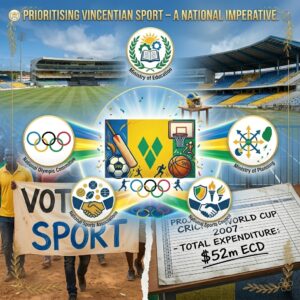
In 2007, the then government boasted the expenditure of over $50m ECD on Cricket infrastructure to host ‘warm up matches’ in the International Cricket Council (ICC) World Cup for men – 50 overs. On the very first day of competition, the toilets in the newly constructed double decker stand stopped working and were neverf repaired until in 2024, when we hosted the ICC T20 World Cup for men. Indeed, since 2007, the prestigious Arnos Vale #1 cricket facility deteriorated without repair through to 2024.
The Arnos Vale #2 cricket ground, which had also undergone significant repairs in 2007, suffered a change of plans as the organisers decided it would betters erve as Overlay during the World Cup rather than a warm-up faciity.
In 2024 the ‘Party Stand’was replaced by a special arena for patrons willing to play around in some small pools while matches were being played in 2024, during which time it was never full of patrons; not our culture. The government boasted of finally installing lights and an electronic scoreboard.
In 2015, the National Lotteries Authority (NLA), a money-making institution whose mandate was iriginally, ‘to support sport and culture’ borrowed $6.5m from the National Inmsurance Services, ostensibly to be expended on sporting infrastructure. The only problem was that this loan was negotiated shortly prior to the generale l;ections of that year.
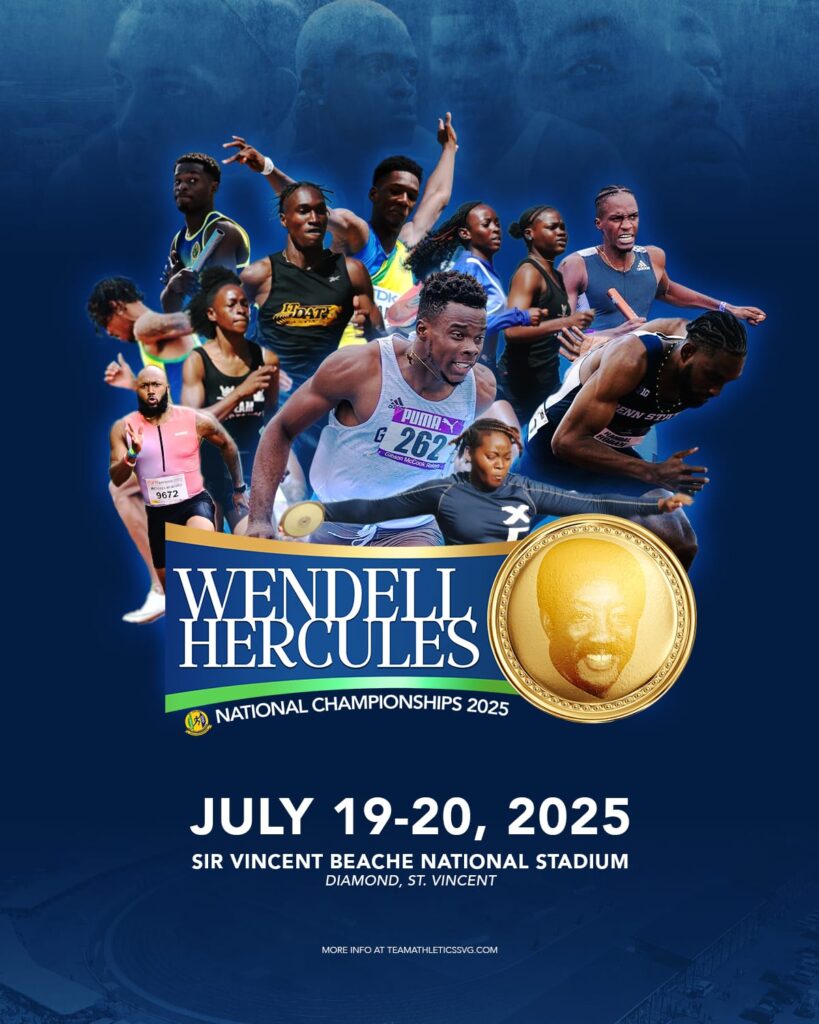
In 2020, a few days ahead of the general e;ections, the synthetic athletics track and Diamond was officially opened.
Despite the National Sports Council Act’s (NSC) mandate of holding responsibiity for the identification, construction and maintenance of all government sports facilities, the NLA constructed several sports faciities, which, unlike those under the NSC, has fully employed staff, lights and fenced perimeters.
The National Sports Policy is hardly referenced beyond the waiver of duties on equipment for national sport federations and official leave for sports personnel to participate in activities at home and abroad under the rubric of ‘national duty’.
Generally, from a government standpoint, there is no official body overseeing the development, implementation, monitoring and evaluation of sport in the nation. In the absence of the foregoing organisation the Ministry of Sport, the NSC and the NLA exist with seemingly distincy mandates relating to sport, independent of each other and without clearly identified vision, mission and measurable goals. What successes are achieved in sport in St Vincent and the Grenadines have little to do with the existing governmental agencies.
Shaping the future of sport in SVG
There is a new government in place, now into its sixth month in office. Political statements, consistent with campaign promises, and, some change of p[ersonnel have been taking place with others yet to be announced. What has not yet been done is communication with the Vincentian public about what is being done in respect of the location of sport in the shaping of the nation’s social, economic and political future.
Sport and Development
The government must adopt an approach that is founded upon treating sport as an important social institution of the populace. This aproach speaks to sport development.
Sport must also be treated as a critical pillar of the country’s development, alongside other identified pillars.
We must therefore cultivate and encourage Sport Development and Sport for Development. To do otherwise would be to ignose all of the benefits that sportc an bring to the nation of St Vincent and the Grenadines.
Research
There is an urgent need for us to begin our new approach founded on scientific research. Our policy and everything that flows from it must be supported by clearly planned and executed scientific research.
It is imperative that we gather data on the state of sport in St Vincent and the Grenadines in all aspects. The findings will become the foudnation pillar of sport data for St Vincent and the Grenadines upon which future research would be undertaken, allowing for periodic monitoring and evaluation of progress or lack thereof.
Key features must include the history of the various sports practised in the country, structure, legal status, membership (clubs/schools), facilities, equipment, athletes, personnel (athletes, coaches, nutriotionists, sports psychologists, others), and competitions (local, regional, international), Primary needs, etc.
The planning of the research must be undertaken by persons possessive of the relevant expertise and experience. It must be meticulously done with full public knowledge and generated interest in the nation’s different media. It must be part of the broader sportg education process, the opathway to cration of a genuine national sport culture.
Consultations
There must be extesive consultations undertaken as an important feature of the process of understanding what sport needs in St Vincent and the Grenadines. The data colected must be discussed with the stakeholders of sport – national federations, journalists, sponsors, government officials, sport fans, PE Teachers and the general public.
There is every reason for the consultations to be public. This allows for the transparency to be part of the sport culture that is needed for the nation. In a sense this will strengthen the broader national culture that the government has already enunciated, one that is characterised by people involvement in all aspects of Vincentian life, including governance with its core elements of honesty, transparency and accountability.
As with the research mentioned in the earlier segment of this Column, the report on the consultations must be made public. If sport is to be apillar of the broader national development strategy then there must be no fear of full discolosure in the approach to what it becomes.
Policy
Following the research and the aforementioned consultations, the process of formulating a comprehensive national sport policy must be undertaken. Since there is a national sport policy in place in St Vincent and the Grenadines, the outcomes of the research and consultations will allow for an extensive review of this document. The resut iof this klatter exercise would perhaps lead to an enturely new and more comprehensive document that could serve the next several years.
Policies often last for some time. However, it must be subject to periodic reviews as the global environment often necessitates critical changes of policies if they are to be relevant and forward looking.
In the case of St Vincent and the Grenadines, the national sports policy has not been the subject of review since the latter part of 2001. Much has changed in the global environment over the past two and a half decades, leaving our sport policy an archaic document, out of touch with today’s realities.
The national sport policy must be in sync with the broader national policy framework of the government at any point in time, allowing for consistency in the development roadmap and the resultant National Development Plan.
It is the policy that offers the requisite guidelines and parameters of the government, in all its several aspects.
Strategic Plan
The national sport policy must be followed by the development of a strategic plan for this particular aspect of national development. This plan must be consistent with and an integral part of the government’s national development plan.
Action Plans
Once completed, the strategic plan for sports in St Vincent and the Grenadines must be used to create specific action plans which are very precise and time-bound. Here again, there must be consistency with the government’s national development plan.
Conclusion
Historically, there is a tendency for government and the public to see sport as frivolity, a mere means of recreation. Over time, however, we have come to an appreciation of the growth and development of sport into one of the festest growing industries in the global environment.
Here in St Vincent and the Grenadinesm, we must professionalise our approach to sport. We must encourage our students to see, understand and aggressively oursue careers in the ever-expanding fields of sport, making it all the more integrated into national development strategies even as the field further develops.
With a new government in place we expect a more professional approach; one that adheres to the fundamental principles of good governance in all aspects. We must seize the opportunity to build strong and vibrant sport policies, plans and programmes that allows us to take our rightful place alongside the rest of the world, fully confident of our capabilities to achieve excellence.