Coventry, Senegal And Africa Create Global Sporting History Fest
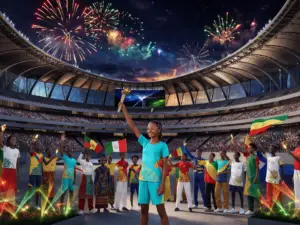
Amazing! Fantastic! Incredibly beautiful! These were just a few of the superlatives that resonated around the Abdoulaye Wade Stadium in Diamniadio, a new city, located 30km from Dakar, the capital city of Senegal, during and following the official Opening Ceremony of the IV Youth Olympic Games (YOG) on the evening of Saturday, 31 October 2026. Indeed, at the time of writing this week’s column, the international media continue to feature highlights of the Opening Ceremony as well as delve into the historical significance of all that is happening around this particular edition of the Youth Olympic Games and the challenges facing their future.
Senegal’s place in global Olympic and sporting history has been secured in grand style. This cannot be changed but instead serves as an important milestone that offers Africa to the world of sport and, through this, the potential for the unification of African people, globally.
Historical features
We are living in a time when global sporting history continues to emerge at almost every turn, something that all involved in sport must research, analyse and respond to with firm conviction or risk being relegated to the dung heap of history.
First Olympic Games in Africa
The IV Youth Olympic Games are the first major sporting event of the Olympic Movement to be hosted on African soil. This historical fact marks a major milestone for sport on the African continent, even though it cannot be compared with hosting the Summer Olympic Games.
Originally, the IOC’s Executive Board announced on 8 January 2018, the award of the YOG 2022 to Dakar, Senegal, to be held during the period 22 October – 9 November. At the time of its decision, A release from the Association of National Olympic Committees (ANOC) stated that ‘The dates have been chosen to benefit the large majority of athletes and their school curriculum. It will also mean the YOG takes place at the start of the dry season and coincides with Africa Youth Day in Senegal.’ It was also stated at the time that the decision on the dates came after ‘extensive consultation with National Olympic Committees, International Federations and the IOC Athletes’ Commission’.
The onset, duration and unsettling impact of COVID in 2020 that forced the postponement of the Summer Olympics in Tokyo, Japan, from 2020 to 2021, also forced a mutual agreement between the IOC and Senegal toa proposal of the nation’s president at the time, Macky Sall, to then IOC President, Thomas Bach, to postpone YOG to 2026. The IOC’s Executive Board announced its decision on 15 July 2020. The new dates agreed upon were 31 October – 13 November 2026.
When current Senegalese President, Bassirou Diomaye Faye, declared the IV Youth Olympic Games open, on the evening of 31 October, it ushered in a new phase in sport and the Olympic Movement in Senegal but also in every African nation. Indeed, the opening ceremony addressed this important aspect throughout the cultural presentations. It was not lost on Africans everywhere.
First female IOC President
On 20 March 2025, 49 of the 97 IOC members in attendance at the 144th IOC Session in Costa Navarino, Greece, voted, overwhelmingly to elect Zimbabwe’s Kirsty Coventry, as the 10th President of the organisation, and, historically, the first female to be so honoured. There were no abstentions not any votes against. Completely overwhelmed by what must have been a crowning achievement in her already distinguished Olympic career, she declared, ‘I am particularly proud to be the first female IOC President, and also the first from Africa. I hope that this vote will be an inspiration to many people. Glass ceilings have been shattered today, and I am fully aware of my responsibilities as a role model.’
She was officially inaugurated on 23 June 2025, International Olympic Day, commemorating the founding of the IOC and the Modern Olympic Movement.
It was Brian Lewis, then President of the Trinidad and Tobago Olympic Committee (TTOC) and of the Caribbean Association of National Olympic Committees (CANOC), who, while a panellist at the IOC organised, Olympism In Action, held on the fringes of the III Youth Olympic Games held in Buenos Aires, Argentina, 5 – 6 October 2018, used his voice in the Session on Women in Sport, issued a clarion call for the
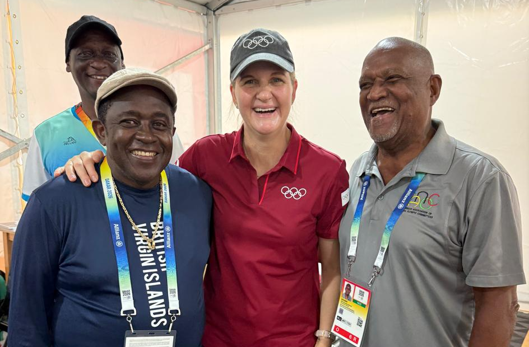
IOC President, Kirsty Coventry, flanked by Ephraim Penn (BVI), President of the Association of National Olympic Committees of the OECS (ANOCES) and Keith Joseph (SVG), President of the Caribbean Association of National Olympic Committees (CANOC), share a moment together at the Sport Exhibition, Youth Olympic Games, Dakar, Senegal
IOC to ‘put its money where its mouth is and elect a woman as its next President!’ Happily, Brian is still involved in the sport movement, and is duly credited by CANOC in particular, for his commitment to the cause and witness to Coventry’s ascendancy to the presidency of the IOC.
The IOC, generally, has been a strong advocate for women in sport and eventually transitioned to the promotion of gender equity. This approach has paid handsome dividends for the IOC and over time, there has been significant progress in the number of women who have been elected to leadership positions in almost every aspect of sport under the ambit of the Olympic Movement as well as in the broader global sport environment.
Coventry’s rise to the leadership of the IOC, will undoubtedly, serve as impetus to women in sport everywhere. This is already being noticed across the globe. In the Caribbean, for example, women have made progress in every aspect of sport. There is now greater interest by younger categories of women in upward mobility is the ever-expanding opportunities in sport, as is also the case in other fields of endeavour in society. This augurs well for the future of sport and gender equity across the Caribbean.
First African IOC President
Becoming president of the IOC is one thing, however historic. Becoming the first IOC president to have emerged out of the beautiful continent of Africa, where colonisation, transatlantic slave trade and slavery, economic and cultural exploitation dominated the landscape for centuries, catapults us who have any historic links with Africa, onto another sphere altogether.
Once she accepted the challenge that comes with being the IOC president, Coventry insisted on impressing her stamp of authority on the institution, ushering a novel approach under the theme, ‘Fit for Purpose’. This comes after two terms of Thomas Bach whose focus was ‘Change of be Changed’ and served up Olympic Agenda 2020 and then Olympic Agenda 2020 +5.
Clearly highlighting her Africanness speaks volumes in respect of Coventry’s commitment to taking the continent with her going forward. Of course, she is well aware of her global responsibility but she also understands the rich sporting heritage of the continent and must have been decidedly thrilled looking on at a tremendously emotional opening ceremony that endorsed the unity of Africa and the continent’s developmental potential locating sport as a critical pillar of economic and social development for all.
Africa and Africans come together
World Athletics recently announced that it has awarded the 2029 World Championships to Nairobi, Kenyan the first time that the continent will host the international federation’s major competition. According to World Athletics, ‘The championships will build on a growing record of successful World Athletics events staged across Africa. Kampala in Uganda hosted the World Cross Country Championships in 2017, Nairobi staged the World U18 Championships later that year and the World U20 Championships in 2021, while Gaborone in Botswana hosted the World Athletics Relays in 2026 – the first edition of that event to be held in Africa. Together, those events have helped build significant experience and expertise in staging global athletics competitions across the continent.’
With Dakar’s hosting of the Youth Olympic Games 2026, the continent of Africa shows itself not only keen on continuing a tradition of wanting to host major sporting events but also that it is eager to use sport to build the entire continent.
CANOC’s recent signing of a Memorandum of Understanding with the Association of National Olympic Committees of Africa (ANOCA) serves to highlight the importance of bringing the African descendants in the Caribbean on board in the formation of historic alliances through sport at the same time that CARICOM is engaged in discussions with an increasing number of African nations. It should be noted that the foregoing initiatives come at a time when global geopolitics is undergoing rapid, unpredictable changes. New alliances are emerging everywhere and it is in the individual and collective interests of Caribbean sporting organisations must come on board, playing a leading role amongst those intimately involved in shaping the global future.
We cannot afford to be mere bystanders in global affairs. The work of our predecessors in conceptualising the West Indian Federation, CARIFTA and CARICOM, must be catalysts for the future we are compelled to build. Like our Nobel laureates and athletes, the Caribbean can and must stand up, together.
The Caribbean must work to establish the Caribbean Games on a firm footing. The CANOC General Assembly held in Curacao 0n 18 October 2026 received with much enthusiasm, the expression of interest by the nation’s multisport organisation, fully endorsed by the government, represented by Prime Minister Gilmar Pisas. That is a step in the right direction and must be pursued with much commitment and determination to succeed.