Restructuring of Vincentian Sports – An Urgent Necessity
There is a new government in place in St Vincent and the Grenadines and despite the vainglorious boasting of the former government over the past 24 plus years the reality is that there is much work to do in all aspects of national development.
Whilst the formed government showcased some projects, they are all far from being evidence that sport was ever considered a national priority, except in respect of being an attraction of the electoral votes of the nation’s youths every five years.
St Vincent and the Grenadines is yet to recognise sport as an important pillar of the Vincentian economy. Until this is done, we will be condemned to pinch-hitting, here and there, with no comprehensive forward-looking policy, appropriate structure and cohesive sense of direction.
There is therefore a sense of urgency for a comprehensive review of the location of sport in Vincentian national development to be undertaken.
One does not wish to unduly pressure the new government into acting on all fronts at the same time as they do have to get their feet wet given that they have only recently taken office. The reality, nonetheless, is that during the most recent electoral campaign, the New Democratic Party candidates did make much of their preparation for governance and hence the electorate are eager to have evidence of this.
Patience is necessary, all around.
The government will, in due course explain to the nation, what are the priorities and how they will be addressed.
While we wait to hear from the government, sport continues, much like every other aspect of national development, and there are priorities that are in glaring need of very urgent attention.
Policy
The current National Sport Policy is long out of date. The last review of the policy was around late 2001/2002, at which there were some minimal tinkering at the fringes. The government therefore remained, for two decades, playing around sport, tacking on this here and there, with no clear sense of direction. Not surprisingly therefore, whilst some buildings and other sport facilities have been constructed and this or that agency allowed to host and or compete in events with government support, there has been no sense of cohesion regarding the role of sport in the nation-building process.
National sport policies of any country must always be subject to periodic review if it is to maintain relevance in the global, regional and local circumstances. Policies do not remain static. The fact that our national sport policy has not been reviewed for more than two decades, means that we have allowed ourselves to be left well behind. This is an abomination because while we celebrated the odd fanciful sport facility we were making on genuine progress.
For far too long, Vincentians have been sold the nonsense story of progress and a gravitation towards first-world status when in fact, we were only deluding ourselves.
Our approach to sport has never been one where sport is a designated major pillar of national development. There has been no evidence of the practice of sport for development.
There is therefore an urgent need for a comprehensive review of the policy to be undertaken, and in short order. Without this, much of what obtained in the past will continue, to the detriment of our society.
Structure
A well-crafted national sport policy will lead to the establishment of a structure that will facilitate the development of appropriate strategic plan over the years, reviewed in a timely manner at once reflecting the progress made and meeting the requirements of global changes and attendant challenges.
Structures are not immutable. Because of the pace at which the global environment is changing and the impact of these changes on societies around the world, they either change or find themselves being changed by those outside forces. This is also the reason that an organisation is always in motion. The governance of any country goes through these same experiences.
In St Vincent and the Grenadines, therefore, the existing sport structure bears no relevance to contemporary sport at the global level.
We have in place in this country, an official Ministry in which sport is merely one of the portfolios. There is no clear indication of the importance of sport in the ministerial structure. One can only hazard a guess of the level of its importance accorded sport in the complex ministry by the financial allocations during the annual budget presentation, viz-a-viz the other portfolios of the same ministry.
There is therefore a structural problem for sport, from the very outset, in so far as the broader ministerial structure in which it is located is concerned.
There is no clear determination of the role of what constitutes the Ministry of Sport.
The Ministry of Sport therefore is often relegated to being a Department rather than a ministry in the strict sense and hence, receives the attention commensurate with its status.
There is no clear understanding of the role of the Ministry of Sport and the annual influx and departure of scores of young people who are engaged in the Youth Empowerment Service (YES) programme, viz-a-viz the mandate of the ministry and its role in national development.
Then there is the National Sports Council (NSC), which is supposed to function under the official NSC Act.
The NSC Act is itself outdated. Indeed, the mandate of the ACT speaks to the NSC being responsible for all sports facilities with the exception of the Victoria Park, which, at the time of the passing of the original Act, fell under the ambit of the Kingstown Town Board. Of course, over the past several years, the Victoria Park appeared to fall, more under the National Lotteries Authority (NLA) than anywhere else.
The nation’s sports facilities suddenly appeared to have fallen under two separate streams. Part fell under the NSC, while others were developed under the ambit of the NLA. How it was determined where any particular sport facility fell, remains anybody’s guess. What has been clear, however, is that those facilities under the NLA were significantly better off than those that were under the purvey of the NSC. This never seemed to bother anyone in authority.
The original NSC Act, made allowances for the establishment of a National Sports Assembly (NSA) made up of all the national sports associations in St Vincent and the Grenadines. This was an advisory body to the NSC, with no decision-making authority. This latter fact led to lack of interest of national sports associations; hence the NSA has never been fully established and operational.
Several attempts to establish Community Sport Councils have faltered. The NSC has, over time, become a grouping of well-meaning individuals, with no real impact on the sport development process in St Vincent and the Grenadines.
Facilities
The nation’s sport facilities have, over the years, been at the mercy of government ministers, for whom, they are important for garnering electoral votes, rather than be fully integrated into the broader national development matrix. Nowhere has this been more evident that in the political campaign messaging of candidates during the most recent general elections. The electorate were simplistically advised from one platform to another of the benevolence in the provision of facilities located in places that the candidates through appropriate rather than be encouraged into an appreciation for the role of sport in nation-building.
Not surprisingly, therefore, despite an array of indoor sports, no administrative attention has been paid to the establishment of an indoor sports facility for the adherents of any of the sports.
There are no clear guidelines, anywhere, with regard to the hosting of regional and international sport competitions. This explains why some sport facilities are often hastily constructed or upgraded after the announcement of one sport or other earned the right to host this or that regional/international competition.
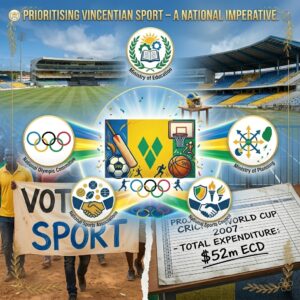
52 plus million dollars were apparently expended by our government on cricket facilities for the hosting of the warm-up matches of the Cricket World Cup 2007. The entire episode was a disaster in many respects. There were no apologies and the cricket authorities ran afoul of the cricket-loving fans for the total disrespect shown to them in the arrangements that negatively impacted spectators. It took 17 years before the toilets in the newly constructed double-decker stands could have had its toilets repaired and the facility receive the comprehensive repair work that is now evident.
The multi-million sport facility at Diamond, the stadium, is a model of the failure to plan sport facilities development and maintenance. Moss formation and track discoloration are commonplace. There is no permanent facility management located at the facility. The development of the sport infrastructure at Diamond appears to be something of a national secret.
Since March 2025 then minister and ministry officials were informed that the licence from World Athletics for the tract will expire in January 2026. To date, no response has been received and there are two weeks left in the month.
Conclusion
The absence of a clearly enunciated, comprehensive sport policy framework has led to a plethora of inadequacies all around.
One can only hope that meaningful change will come and in a timely manner. The current situation in respect of our approach to sport is unacceptable.
Globally, sport continues to be an attraction for young people. It is also one of the most important ingredients is sustaining a healthy, productive nation.
Let the process of change begin!