Remembering Caribbean Achievements at the 1966 Commonwealth Games
Caribbean sport is currently taking centre stage as we are all being called to celebrate a unique historical achievement.
During the period 4 – 13 August 1966, Kingston Jamaica hosted the VIII British Commonwealth Games. Duncan Mackay of Inside The Games, reminds us that this was the third name change for the sporting spectacle since they began in Hamilton, Canada, in 1930 as the British Empire Games.
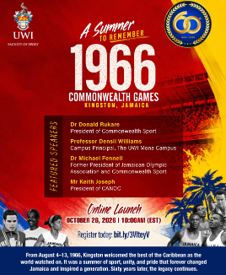
Dean of the Faculty of Sport at the University of the West Indies, Dr Roy McCree, is the brainchild of the celebration, dubbed, ‘A Summer To Remember’, and which was officially launched Online, at 10.00am, Thursday 29 October 2026.
The launch featured a welcome and brief introduction by Dr Mc Cree, followed by presentations from the current president of Commonwealth Sport (formerly Commonwealth Games Federation), Dr Donald Rukare of Uganda, Professor Denzil Williams, Campus Principal, UWI Campus, Mona, Jamaica, Dr Michael Fennell, Former President of the Jamaica Olympic Association (JOA) and of Commonwealth Sport (CS), and Keith Joseph, President of the Caribbean Association of National Olympic Committees (CANOC), of St Vincent and the Grenadines.
The attendees to the official Online launch of the celebrations were in excess of 80 persons, including several of the actual participants and medallists at the historic Games back in 1966. To many, the launch signified an important milestone in Caribbean sporting history in so many aspects that will forever remain with successive generations of the people of the region. Caribbean athletes delivered what may still be on record as one of the most stunning examples of what our athletes are capable of on the international stage and the region’s capacity to host mega sporting events.
The launch was nostalgic but also a source of joy and an inspiration.
The historic backdrop
It is important to remember that at the political level, the English-speaking Caribbean countries of Antigua and Barbuda, Barbados, Dominica, Grenada, Jamaica, Montserrat, St. Kitts-Nevis-Anguilla, Saint Lucia, St. Vincent and the Grenadines, and Trinidad and Tobago.established the West Indies Federation effective 3 January 1958. British Guiana (Guyana) and British Honduras (Belize) were accorded Observer Status. The Federation was approved under the British Caribbean Federation Act, 1956.
During the period of the Federation the International Olympic Committee (IOC) accepted the West Indies Olympic Committee as the official representative organisation for the region, replacing their former individual membership. The Committee participated in the Pan American Games of 1959 (Chicago, Illinois) and the Summer Olympics (Rome, Italy).
Unfortunately, the ambitious project, the West Indies Federation, collapsed following a referendum in Jamaica that saw voters support the Alexander Bustamante campaign against the new institution, citing the lack of resources amongst the smaller islands and the fear that their populations would rush to the more-resourced Jamaica and compete for jobs, housing and the like, bringing down the country’s economy. Subsequent to Jamaica’s decision, Trinidad and Tobago’s then Premier, Eric Williams, declared the infamous line, ‘One from 10 leaves nought’, indicating the immediate collapse of the Federation.
31 May 1962 was the official date recorded for the Federation’s demise. Jamaica then became Independent on 6 August 1962, followed on 31 August of the same year by Trinidad and Tobago. The rest is, as we say, history.
The collapse of the West Indies Federation opened the way for the newly Independent nations of the Caribbean to return to the IOC as individual members.
At the time of the Commonwealth Games in Jamaica, several of the smaller Caribbean countries did not have National Olympic Committees nor Commonwealth Games Associations. In several instances, therefore, given the relationship with England and with the International Amateur Athletics Federation (IAAF) the local governing body for athletics served as the official national representative organisation on the Commonwealth Games Federation. St Vincent and the Grenadines was one of those countries to be so represented.
Pathway to hosting the Commonwealth Games 1966
Jamaica’ first major foray in international sport came at the 1948 Olympic in London, UK, where Arthur Wint won the 400m, equalling the then world record of 46.2, with Herb McKenley, finishing second. Four years later, at the Olympics in Helsinki, Finland, George Rhoden won individual gold in the 400m ahead of McKenley in second. The two joined forces with Laing and Wint to win the 4 x 400m relay. McKenley got silver in both the 100m and 400m, respectively.
It was not surprising therefore that at the Assembly of the Central American and Caribbean Sport Organisation (CACSO) now Centro Caribe Sports (CCS) in Caracas, Venezuela, ahead of the CAC Games there in 1959, Jamaican delegates, Benny Machado and Herbert MacDonald, successfully bid for their country to host the IX CAC Games, 15 – 28 August 1962, with support of both the goivernment and Opposition parties. At the time of the winning of the bid Jamaica was associated with the West Indies Federation and the West Indies Olympic Committee. Norman Manley was the country’s Premier. The country became the first English-speaking country to host the CAC Games which began in 1926. The undertaken proved ambitious but successful.
The national stadium was constructed for the hosting of the CAC Games in 1962. It was officially opened a few weeks after the defeat of the Manley government in the Referendum and a few days after the country became Independent.
At the meeting of the Commonwealth Games Federation held in Rome, Italy, during the Summer Olympics, Jamaica was awarded the VIII Commonwealth Games, 4 – 13 August 1966. The votes were: Jamaica, 17 votes, Edinburgh, Scotland (12 votes) and Salisbury, Rhodesia and Nyasaland (5 votes). The facilities constructed for the hosting of the CAC Games of 1962 were deemed appropriate for the Commonwealth Games despite fears by the larger nations that the country was too small to successfully do so. They would all be proven wrong.
Jamaica was the first non-white country to host the Commonwealth Games at the time.
VIII Commonwealth Games 1966
The Commonwealth Games of 1966 saw participation of 1050 athletes from 34 Commonwealth countries competing in 110 events for 340 medals.
Athletes from the Caribbean performed extremely well, perhaps delivering their best showing at the Games up to that time. Trinidad and Tobago finished fifth overall, led by the men’s 4 x 440yds relay world record breaking golden performance, Roger Gibbon’s double gold medals (1000m Time Trial and Match Sprint), Wendell Mottley’s individual 440yds gold and Hugo Gittens’ weightlifting gold. Medals were also won by Kent Bernard (440yds silver), and Edwin Roberts (bronze in the 100yds).
For its part, Jamaica earned 16th place, overall. The Men’s 4 × 110 yards relay team of Lynn Headley, Michael Fray, Pablo McNeil and Wes Clayton, earned silver, while the Women’s 4 x 110yds relay team of Adlin Mair-Clarke, Carmen Smith, Una Morris and Vilma Charlton won bronze. Carmen Smith won in the 80 metres hurdles. George Kerr (880yds) earned a bronze medal, Wellesley Clayton copped bronze in the long jump and Una Morris finished third in the 440yds..
Tom Robinson of the Bahamas was second in the 100yds as did John Morbey of Bermuda in the long jump. Anton Norris of Barbados was third in the high jump. Clive Long of Bermuda placed second in the Decathlon with 7123points.
St Vincent and the Grenadines was represented by Victor Peters (220yds, 440yds) and Ayrton Clouden (Javelin). Both men were unsuccessful in their respective competitions.
Peters competed in the sixth heat of the 440yds and finished fifth in a time of 48.9 seconds. In the sixth heat of the 220yds he finished sixth in a time of 23.4 seconds. Clouden finished 12th in the Javelin throw with a best of 147 ft 4 in. He was originally entered in the pole vault but did not participate in the event.
Interestingly, Vincentian, George Manners, residing in England at the time, represented that country and earned himself the silver medal in the 90kg Combined weightlifting competition.
Remembering 1966
CANOC has engaged with the UWI Faculty of Sport by way of a Memorandum of Understanding (MoU) signed at the General Assembly in Barbados in 2023. One of the most recent initiatives has been the commencement of discussions on the establishment of a Caribbean Olympic Studies Centre that will ultimately be the repository of sport history across the region and engender sport research.
The decision by the Faculty of Sport to host a schedule of activities commemorating the 60th anniversary of Jamaica’s hosting of the Commonwealth Games in 1966, comes amidst the continuing evolution of the intended programmes of the aforementioned MoU.
The Caribbean has not been proficient in the chronicling of our sporting history. Should this be allowed to continue future generations would not have an appreciation for the achievements that have placed us, most deservingly, in the midst of international sport.
CANOC is well aware of the critical role of universities around the world in promoting research as well as create the enabling environment for the development of courses and study programmes in and for sport, keeping us at the forefront of global developments in one of the fastest growing industries on the planet.
What the project, ‘A Summer To Remember’ does is etch in the minds and hearts of our Caribbean people, the outstanding success of Jamaica, a small country, to become the first non-white nation to host the prestigious Commonwealth Games while the latter was still in its infancy.
The names of Caribbean medallists at the Games in 1966, must never be forgotten, neither must be all who were involved, in one way or another, in the historic success of the event and the message it sent then and still sends around the world, through and beyond sport.
Caribbean history must be about all aspects of life in our region. Sport is integral to our history. CLR James, Michael Anthony, Simon Lister, Hilary Beckles Stoddard, Michael Manley and Roy McCree, are but a few legendary writers of the region’s sporting endeavours.
Conclusion
Many sports enthusiasts across the Caribbean would recall the Southern Games, organised for many years by the TEXACO Sports Club at the Guaraca Park in South Trinidad. This sporting spectacle grew from a two-day international athletics and Cycling competition to a five day affair, two weekends and the intervening Thursday. Spectators at the Southern Games saw some of the best athletes and cyclists in the world while they were all in their prime. The history of the Southern Games must be appropriately recorded for posterity.
Thanks to Dr McCree and all others who have come on board for the celebration of the region’s achievements in 1966 through our engagement in and through sport. At the time of the Commonwealth Games, the region showcased our immense talent in sport but importantly, in our resolve to make successfully possible what many thought we could not have done.
The remembrance programme continues with exhibitions across the UWI’s many Campuses over the next several weeks. This is only the beginning. It is a wetting of the appetite of our Caribbean sportspeople, inclusive of our historians and academics, journalists and storytellers.
Let this celebration of our hosting of the Commonwealth Games of 1966 remind us of our unyielding capacity to achieve.
Let us encourage each other to seriously consider the creation and sustainability of Caribbean Games and commit to greater and consistent collaboration to permanently locate sport as an incredible pillar of Caribbean development.