CREATING A NATIONAL SPORTS CULTURE IN SVG
An all too brief conversation with one of this country’s unrecognised national athletes has occasioned this week’s Column, if only because through the dialogue he kept repeating the all too familiar phrase, ‘over the years, no Vincentian government has shown an understanding, love and genuine commitment to sport and what it can do for the country’.
How often have we found it necessary to use this Column to belabour the very same point?
We can pour through thousands of pages, hundreds of speeches, scores of national budgets and still arrive at the same conclusion: St Vincent and the Grenadines has never officially committed itself to the creation, nurturing and sustaining of a national sports culture.
Through the years, Vincentians have come to expect respective governments and generations of people to show much excitement when sporting successes have been attained, public pronouncements delivered, promises made, all to be forgotten on the dung heap of a blighted history. The aftermath has always been an unforgiving hiatus until the next success comes along.
Woodrow Williams’ death and burial
On 4 August 2026, Woodrow Williams was laid to rest following a most moving and memorable ceremony held at Victoria Park, Kingstown. Reflection on the ceremony leads inevitably to the conundrum that confronts sport in our nation today.
Understanding Woodrow’s life of, in and to sport, his wife, Sherry, immediately conceptualised the Victoria Park as the most appropriate venue for her husband’s burial. Her decision came easily. From the announcement of his death, there was nationwide responsiveness from the entire Vincentian sports fraternity – an honest reflection of the lives he touched.
Woodrow was the epitome of sport in St Vincent and the Grenadines, the embodiment of all that is good, honest and pure, all neatly wrapped in one. There was no boastfulness; no clamouring for social media to sing his praises; no reaching out for accolades and honours. There was only selfless commitment to an ideal: Sport can change lives; sport can change societies.
Shortly after the announcement of Woodrow’s death, the Vincentian sporting community came alive, not in sorrow at his death but rather in glorification of his life’s devotion to sport…of all types.
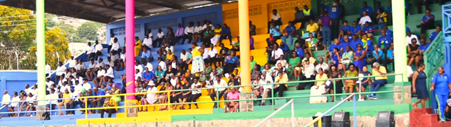
It was the sheer outpouring of love from the nation’s sports fraternity that led to the decision that his best funeral venue would be Victoria Park…a place where all Vincentians who love sport and understood Woodrow’s contribution to his country through sport would get an opportunity to celebrate his awesome, selfless commitment to an aspect of Vincentian culture we all-too-often ignore.
It was amazing that without prompting, this country’s sporting fraternity provided a leadership that the government ignored. The nation’s sports fraternity asked their members to attend the funeral service in a celebratory mood, sporting the national colours.
Former sportspeople returned home from abroad for the first time in years to be part of the ceremony. That is how much his life and work impacted them. They wanted to share in the celebration of his life and to see him one final time, bedecked in a sporting uniform, short pants and all, just the way he would have wanted it… Just the way he was.
The Vincentian sports fraternity made their own choice and served up their own National Funeral for one of this country’s Most Unsung Heroes, Karl Woodrow ‘Keylee’ Williams. So it was that history was made on Tuesday, 4 August 2026, at the Victoria Park. Nothing can ever change that fact.
Where years of paper, constitutional Independence and the political gimmickry of the -renaming’ of the Victoria Park failed, the funeral of Woodrow Williams succeeded. The latter brought a nation together through sport in a very special type of solidarity that we can never forget.
The death and burial of one Vincentian sporting hero, Woodrow Williams, achieved the coming together of a nation, the likes of which we have never before witnessed. Such is the power of sport. Nobody had to tell us about this truth. We experienced it ourselves.
Our nation’s lack of a genuine sports culture did not prevent the nation’s sports fraternity from showcasing ‘people power’. It was indeed ironic that this was made manifest in a celebration of the life of one Vincentian sporting personality, Woodrow Williams.
Forging a Vincentian sport culture
It is said that ‘culture is the way of life of a people’. We speak of material and non-material culture. A culture is founded upon the beliefs, values and norms of the people in a nation. This allows us to speak of a national culture – the behaviour practised by the majority of the members of the society in which they live. Of course, within a nation, we may find that despite the pervasive nature of what we consider the national culture, it is commonplace to find in any given country a variety of subcultures – behaviour practised by subgroupings.
We have now global discourse on the sport culture in different societies and organisations around the world. We often hear it being said that Jamaica possesses a strong track and field culture dating back to the 1940s and 1950s, when the likes of Arthur Wint and Herb McKenley proudly carried the country on their achievements on the track.
Usain Bolt’s dominance of the 100m and 200m for a brief period took the idea of Jamaica’s sport culture to another level, so much so that the world of sport began to speak of ‘Brand Bolt’ equating ‘Brand Jamaica’.
Jamaica’s sport culture was additionally fuelled by the nation’s exploits in cricket, football, boxing, swimming and bobsledding.
Jamaican sports teams are embraced by the nation as being genuinely possessive of the aspirations of the Jamaican people, and this runs the gamut of the entire population.
St Vincent and the Grenadines does not yet have a sporting culture. Over the years, success in sport, albeit sporadic at best, has not been taken into the concept of being Vincentian. The population, inclusive of the government, has not yet come to embrace sport as a way of life for the people of St Vincent and the Grenadines.
It is a most unfortunate truism that in St Vincent and the Grenadines we still observe sport as something outside of us, not in any way the embodiment of our aspirations.
We allow the politicians to jump on the sports bandwagon and lead the charge in telling us how we must celebrate our sporting achievements. The celebrations do not emerge from the bosoms of the Vincentian people. It is the reason why we spent so much time before acknowledging that Adonal Foyle was worthy of national acclaim as much as he was in the USA. It may also be the reason why we never made any genuine effort at encouraging the establishment of a basketball foundation, with his help, that could have served the systematic, sustained grooming of basketballers through the years.
Sport culture in national development
Our sporting achievers are often left out of our nation’s development. This comes as no surprise.
Our education system remains decidedly biased in favour of pure academics. Physical literacy is not even in the lexicon of our education system to the point of attracting the attention of the majority of the population.
Sport is so maligned and chastised as a distraction from academia that parents even find reason to object to their children being asked to procure uniforms for physical exercise and engage in the practise of the discipline at school.
The inclusion of physical education in our schools’ curricula only materialised because the Caribbean Examinations Council (CXC) made it an examinable subject. Even then, it was not taken seriously and left without a foundation in the preparatory and elementary levels of our education system.
To this day, sport is still considered as little more than frivolity and recreation by the majority of the nation’s leaders.
A quick perusal of the major speeches of leaders at almost all levels of Vincentian society seems to ignore the existence of sport. One has only to peruse a sample of the speeches made by politicians on occasions such as the often-held impromptu airport receptions for returning successful athletes to glean the lack of familiarity with the subject of sport and its ever-growing and changing nature.
At Graduation ceremonies, audiences are often left awe-struck when the winner of sports awards is also excellent in their academic subjects. This seems an aberration.
One of the most pathetic pieces of political sham in St Vincent and the Grenadines may well have been the establishment of a system of naming sport ambassadors over the past several years.
The average Vincentian student may be hard-pressed to explain the criteria used to identify persons considered and granted sport ambassador status. Apart from the receipt of a diplomatic passport, most Vincentians have no idea what the receipt of the designation means to the recipient and the population at large.
It was a grand surprise to many; therefore, when the then government media carried an article that stated,
‘Twenty-nine (29) cultural and twenty-five (25) sporting ambassadors in Saint Vincent and the Grenadines (SVG) were encouraged to engage Vincentian youth in the schools and their respective communities to help them develop and advance their skills and talents.‘
‘The call came from the minister with responsibility for the Public Service, Consumer Affairs and Sports, Hon. Frederick Stephenson, while addressing an “Introductory Ceremony for Goodwill Ambassadors” on Wednesday, 27th September, 2023.
‘Minister Stephenson said the ambassadors have a responsibility to the nation’s youth. He urged them to select a school in their communities and work with the children in the respective schools’.
No one has ever articulated how the ambassadors were supposed to carry out their responsibilities when they may never have been involved in any discussions in this regard.
The absence of an understanding of the written national sport policy and its need for periodic review and updating has left this country without any genuine commitment to sport.
The creation of a sport culture is not about money being doled out to athletes. It is about the promotion of a mindset amongst the population of physical literacy’s importance to one’s growth and development as a person, a genuine Vincentian son or daughter.
Unfortunately, we are a society of mimics, still looking outwardly for everything developmental because of our own insecurity about our intellectual capacity to determine who we are and who we can become.
Without a culture, a people can never truly develop enough to determine their own destiny.
Without a sport culture, St Vincent and the Grenadines will continue to ‘mistake the leaves for the forest’, satisfied with patting ourselves on the back whenever we get some sporting success.